From Lou's Meat Counter Notes on YouTube
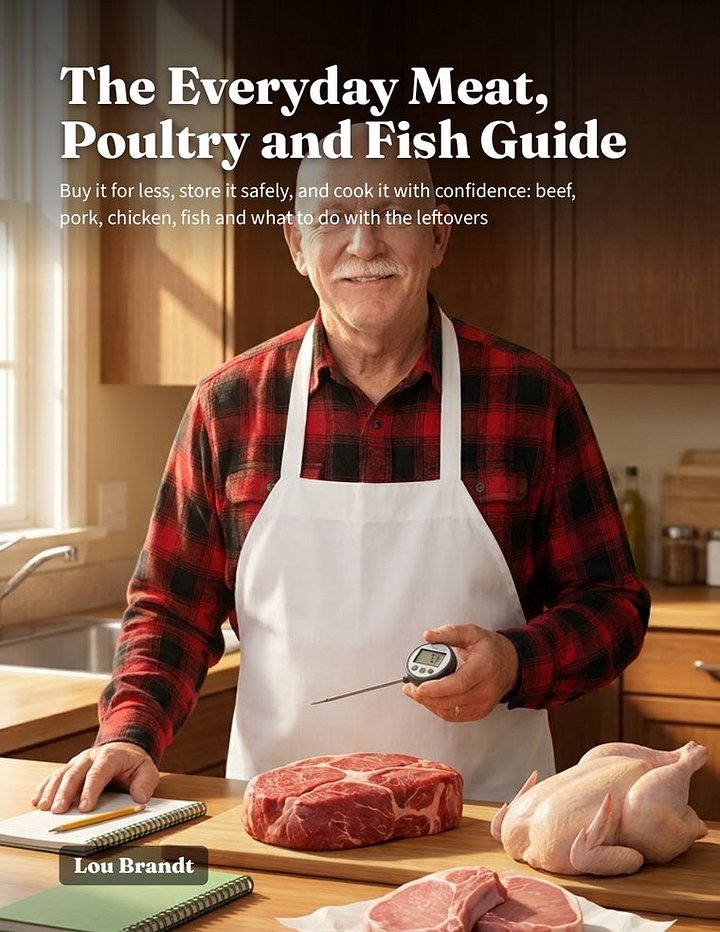
Buy meat, poultry and fish for less, store it safely, and cook it with confidence, without guessing at the meat counter.
A large-print everyday guide for people who do the grocery shopping and the cooking: how to read a price, a date and a label, one chapter for each common cut of beef, pork and chicken, how to buy and bake fish, safe temperatures, freezing and thawing, roasting and braising, and what to do with the leftovers and the bones.
Get the book- Instant PDF download. Nothing ships.
- Large print. Prints on plain paper.
- Works on a phone, a tablet or a computer

Does this sound familiar?
"The date on the package is today. Do I throw it out?"
"I bought the family pack. How long will it really keep?"
"Steak costs a fortune. What can I buy instead that will not turn to shoe leather?"
"How do I know if the fish is fresh, and how long do I bake it?"
"We finished the roast chicken. What do I do with the rest?"
Meat, poultry and fish are some of the biggest things in the grocery cart, and most of us learned about them from our mothers and from guessing. This book gives you a few simple habits you can use on any package: check the unit price, match the cut to the cooking, trust a thermometer over color, keep the freezer organized, and use every bit of what you cook. It will not make you a butcher or a chef. It will help you waste less and spend a little less on every trip.
What you get
- The Everyday Meat, Poultry and Fish Guide (PDF, large print)46 chapters in 10 parts, about 108 pages. Every beef, pork and chicken cut chapter follows the same pattern: what it is, what to look for at the counter, what it costs, how to cook it, the safe temperature, how long it keeps, the common mistake and what to ask the butcher.
- Shopping chaptersPrice per pound, a table of September 2026 national average prices from the Bureau of Labor Statistics, unit price, where to shop, what sell-by, best-if-used-by and use-by really mean, and what Choice, Select, natural and lean actually mean.
- 12 cut chapters, plus beef and pork guidesChuck roast, ground beef, round roasts and steaks, stew beef, flat iron, skirt and sirloin flap, pork chops, pork roasts and ham, bacon, whole chicken, chicken legs and boneless breasts, with a guide to tender and tough beef and a guide to pork cuts.
- Fish, seafood, ground meat and deliHow to tell fresh fish from tired fish, how to store, freeze and thaw it, three sourced ways to bake it, and the safe handling of ground meat and cold cuts.
- Cooking methods with sourced temperatures and timesRoasting, braising and stewing, the slow cooker and quick cooking, with oven temperatures and approximate times from university extension services and the USDA roasting table.
- Safe handling, freezer, thawing and power-outage chaptersClean, separate, cook, chill. One chart of safe minimum temperatures. Portion, wrap, write the date. Three safe ways to thaw. What to check after the power goes out.
- Leftovers, bones and stockHow to cool, store and reheat leftovers safely, how to make stock from a chicken carcass, and a plan to turn one chicken into three meals.
- 14 printable cardsPrice yardsticks, the date words decoded, beef cheat sheet, seven questions for the butcher, safe minimums, how long it keeps, three safe thaws, the freezer label, raw chicken rules, fish at a glance, the power-out card, five swaps and the weekly plan.
- Price list, freezer list, fridge list and 30-day planPages to print: a price list for your own store, a freezer sheet, a fridge sheet, a kitchen checklist and a 30-day plan.
- The full source list39 pages from university extension services, the FDA, the CDC, the USDA and the Bureau of Labor Statistics, with the date I read them, so you can check any number yourself.
Checked, not guessed
Checked against university extension services (Illinois, Minnesota, Nebraska, Arizona, South Dakota State, North Dakota State, Penn State, Oregon State, Missouri), the U.S. Food and Drug Administration, the Centers for Disease Control and Prevention, a USDA fact sheet, a state health department's copy of the federal dating fact sheet, and the Bureau of Labor Statistics price tables.
Every dollar figure in the book is a national average with its month and source. Every temperature, cooking time and storage time comes from a page I opened and read. Where I could not find a number I trust, such as fish prices, I left it out and showed you a method. No company paid to be in the book.
This is general information for home cooks. It is not medical, nutrition or financial advice. If you have a health condition, ask your doctor what is safe for you to eat.
A note from Lou
I'm Lou. I live in Zanesville, Ohio, with my wife Peg and a chest freezer in the garage. For over forty years I've done the meat shopping for my family, and I've asked a lot of questions at a lot of meat counters. I'm not a butcher or a chef. I'm a retired school bus mechanic with a notebook and a thermometer. This expanded edition grew from the neighbors' questions: how to buy fish, how to roast a chicken, what to do with the bones. Every number comes with a source I could find.
Lou Brandt is an AI character created for this channel.