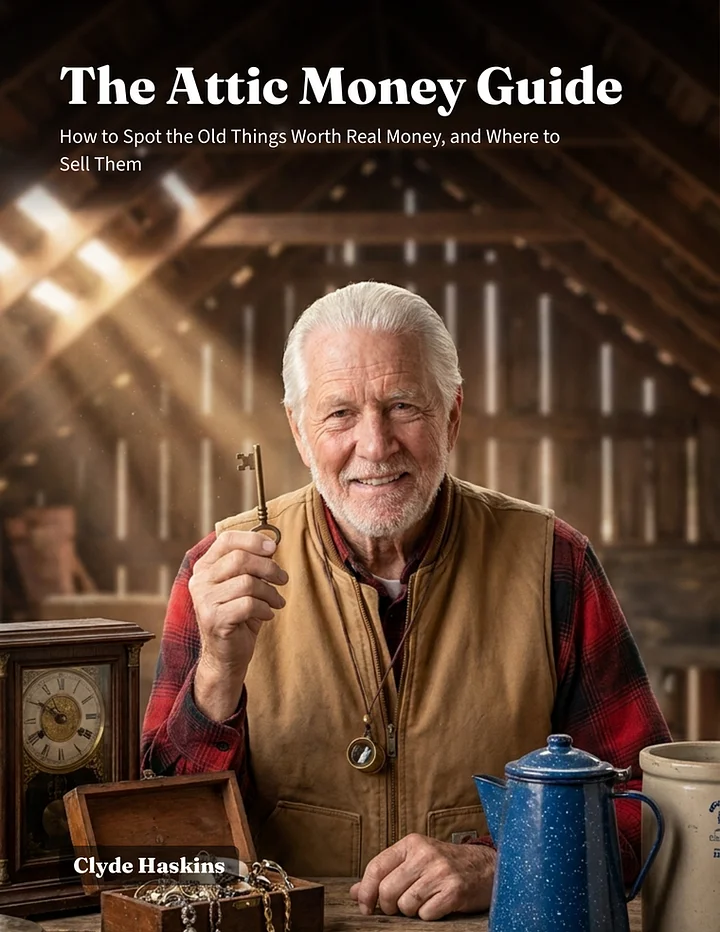
From Clyde's Attic Money on YouTube
Before anything goes in the dumpster, find out what it really sold for.
A large-print guide for clearing out a house: how to spot the old things worth real money, check real sold prices in ten minutes, protect the condition, and choose where to sell. Not an appraisal, a method you can use on anything.
Get the book- Instant PDF download. Nothing ships.
- Large print. Prints on plain paper.
- Works on a phone, a tablet or a computer

Does this sound familiar?
"The dumpster comes Monday and I don't know what's worth keeping."
"A man offered me cash for Mom's gold. How do I know if it's a fair price?"
"I found a drawer full of old keys and a box of bottles. Are they worth anything or is it all junk?"
"I wanted to polish the brass before I sold it. Somebody said don't. Why?"
There is no shortage of advice online. That's the trouble. Most of it is asking prices, big claims and "worth a fortune" headlines. This book gives you one method you can use on anything: look closely, check what it actually sold for, protect the condition, and compare real offers. Most old things are worth a few dollars. This shows you how to find the few that aren't.
What you get
- The Attic Money Guide (PDF, large print)71 pages, 24 chapters in 7 parts, from the five rules for the attic to a 30-day plan. Second edition, November 2026, with checked fees, dated estimates and a source for every figure.
- The ten-minute sold-price methodHow to find what pieces like yours actually sold for, recently and in similar condition, using sold listings for free. A sold price is a fact; an asking price is a wish.
- The jewelry box and the junk drawerGold stamps decoded (10K, 14K, 585, 750), melt math with a pretend price so you can check any offer, silver and plate, coins, clocks and watches, old keys.
- The kitchen, the barn and the attic shelvesCast-iron skillets, stoneware crocks, enamelware, bottles and jars, old signs, brass and copper, pottery marks, toys and lunch boxes, furniture. What to look for, marks and age clues, red flags.
- The room-by-room walk-throughWhat to check in every room before anything is thrown out, with the First 30 Minutes in a Room card.
- Selling wiselyWhere to sell and how to choose, a fees comparison from each platform's own page as of November 2026, what you keep from a $100 and a $1,000 sale, scams and safety, and when to hire an appraiser.
- 10 printable cards and a trackerCheck Sold Prices in 5 Steps, the Photo and Record card, the Never List, the Gold Stamp Decoder, the Melt Math Worksheet, Questions to Ask a Gold Buyer, the Key Quick Check, First 30 Minutes in a Room, the Before You Sell checklist, and Questions for an Estate Sale Company or Auction House.
- The full source list49 sources, dated, so you can check any number yourself.
Look inside
Real pages from the finished book. Tap a page to see it full size.
 The quick index: start where you are, whether you have a weekend, one room or one item in your hand.
 Chapter 2, the Check Sold Prices in 5 Steps card: the free, ten-minute method the whole book is built on.
 Chapter 4, the Never List: why you should not clean, repaint or fix anything before you know what it is.
 Chapter 5, the Gold Stamp Decoder: what 10K, 14K, 585 and 750 mean in plain numbers.
Checked, not guessed
Checked against the U.S. Federal Trade Commission and its Jewelry Guides, the U.S. Fish and Wildlife Service, the American Society of Appraisers, collectors' society pages, public television appraisal pages with their years, and the published fee pages of eBay, Facebook Marketplace and a regional auction house, as of November 2026.
Every dollar figure in the book is a dated example with its source: a televised appraiser's spoken estimate (not a sale), a published fee, or a past sale. Where I couldn't find a number I could stand behind, I left it out and taught you how to check sold prices instead. No company paid to be in the book.
This is general information for hobbyists. It is not an appraisal, and it is not legal, tax, investment or financial advice. Your piece may be worth more or less than any example.
A note from Clyde
I'm Clyde. I live on a farm in Ohio, and for fifty years I've gone to farm auctions and estate sales. I also helped a lot of neighbors empty their parents' houses, and too often I watched something good go in the dumpster, or go out the door for too little. So I wrote down what I wish I'd known. I'm not an appraiser or a dealer, and this book isn't an appraisal. Most old things are worth a few dollars. I'll show you how to find the few that aren't, and how to check what they really sold for.
Clyde Haskins is an AI character created for this channel.